
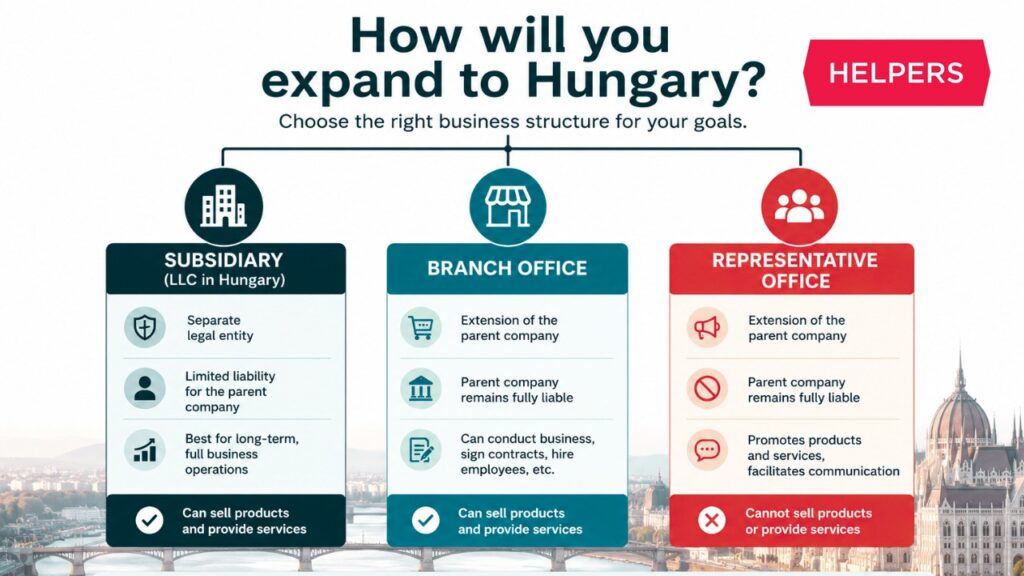
If you already operate a business abroad and are planning to expand into Hungary, you have several options available. The most common solution is to establish a Hungarian limited liability company (LLC), but depending on your goals, a branch office or a commercial representative office may also be worth considering.
Understanding the differences between subsidiary, branch office, and representative office can help you choose the most suitable option for your business. If you need additional help, feel free to contact our team of experts for a consultation.
Option 1: Setting up an LLC in Hungary
The most popular business form in Hungary is the limited liability company (LLC, or KFT in Hungarian). An LLC is an independent legal entity, regardless of whether it is owned by an individual or by another company. One of its main advantages is that the owners’ liability is limited to their capital contribution. In other words, the owners are generally not liable with their personal property for the company’s debts or obligations.
Standalone company vs. subsidiary
If your Hungarian LLC is owned by a foreign company, it is considered a subsidiary. Having a subsidiary can be beneficial for various reasons, for example, it may simplify the transfer of employees to Hungary through intra-corporate transfer. In addition, profits can generally be transferred to the parent company without dividend tax being applied.
For most international businesses planning long-term operations in Hungary, establishing a subsidiary is often the preferred solution because it combines operational flexibility with limited liability protection.
Option 2: Opening a branch office in Hungary
A branch office is not a separate company, although it must be registered in the Hungarian Company Registry. It is an extension of your foreign business, meaning that its activities are all performed on behalf of the parent company rather than in its own name.
The branch office cannot be sold, and if the parent company is liquidated, the branch office must be liquidated too. Additionally, the parent company remains fully liable for all obligations, debts, and damages – which is a major disadvantage compared to setting up a subsidiary.
Activities a branch office can do on behalf of the foreign parent company:
- Sign contracts
- Hire employees
- Rent office or retail space
- Conduct commercial activities in Hungary
Taxation and administration
Branch offices are registered in the Company Registry, and they are generally taxed in the same way as Hungarian companies. They are required to pay:
- Corporate tax
- Local business tax
- Any other taxes required under Hungarian law
When establishing a branch office, the parent company’s articles of association must also be submitted. In addition, branch offices must create an annual report and be audited every year unless the parent company is based in another EU member state.
Example
Imagine that a foreign manufacturer wants to sell its products directly in Hungary.
Customers can visit the branch office or store and purchase products there. The branch office can sign lease agreements and employment contracts, but always on behalf of the foreign parent company. The parent company remains responsible for all related obligations and liabilities.
Option 3: Establishing a commercial representative office
A commercial representative office is also an extension of a foreign company, but its role is much more limited. Unlike a branch office, it cannot conduct business activities or generate revenue in Hungary.
What can a representative office do?
A commercial representative office may only:
- Promote the products or services of the parent company
- Facilitate communication between clients and the parent company
- Prepare contracts for signature by the Hungarian client and the foreign company
What can it NOT do?
A representative office cannot:
- Sign contracts in its own name
- Sign contracts on behalf of the parent company
- Sell products or provide services directly
- Carry out commercial business activities
As with a branch office, the foreign parent company remains fully liable for the office’s activities.
Taxation and administration
Since a representative office does not engage in business activities, it is not included in the Company Registry, and it is not subject to the Hungarian Accounting Act. As a result, it generally:
- Does not prepare annual financial statements
- Does not pay Hungarian corporate tax
- Does not pay local business tax
The parent company remains responsible for taxation in its home jurisdiction.
A representative office may, however, register for VAT when necessary to support the parent company’s activities in Hungary.
Example
A car manufacturer may open a showroom in Hungary through a representative office.
Potential customers can visit the showroom, inspect vehicles, and receive information. However, they cannot purchase a car directly from the representative office. The sales contract must be signed directly with the foreign parent company. Similarly, lease agreements for the showroom and employment contracts are concluded directly by the parent company.
Which structure should you choose?
The best option depends on your business goals, planned activities, and risk tolerance.
An LLC (subsidiary) may be the best choice if:
- You want a fully operational Hungarian business.
- You want to limit the liability of the parent company.
- You are planning long-term operations in Hungary.
A branch office may be suitable if:
- You are comfortable with the parent company assuming full liability.
- You want to be closer to customers without moving your entire operation to Hungary.
A commercial representative office may be appropriate if:
- You are comfortable with the parent company assuming full liability.
- You only need a local presence for marketing and business development.
- You want to explore the Hungarian market before making a larger investment.
If you are unsure which structure best fits your plans, feel free to tell us more about your business goals. We can help you determine the most practical and cost-effective solution for expanding into Hungary.
Our team of experts
Helpers Hungary has 20+ years of experience supporting people and businesses coming to Hungary. Take advantage of our expertise and let our committed team find solutions tailored to your needs.
Did you like this article? Follow us on Facebook, or sign up for our monthly newsletter to get the latest updates on business operation in Hungary.